


There is traffic. And then there is traffic that buys. But attracting such traffic is easier said than done. The only way you get there is a smart eCommerce SEO strategy – one that actually understands how people scroll and shop.
That said, the days of stuffing keywords into product pages or obsessing over image alt tags are behind us. And we are definitely not going to tell you those SEO tactics still work. Instead, we will share 9 eCommerce SEO strategies based on how people actually interact with online stores now.
What Is eCommerce SEO Strategy?
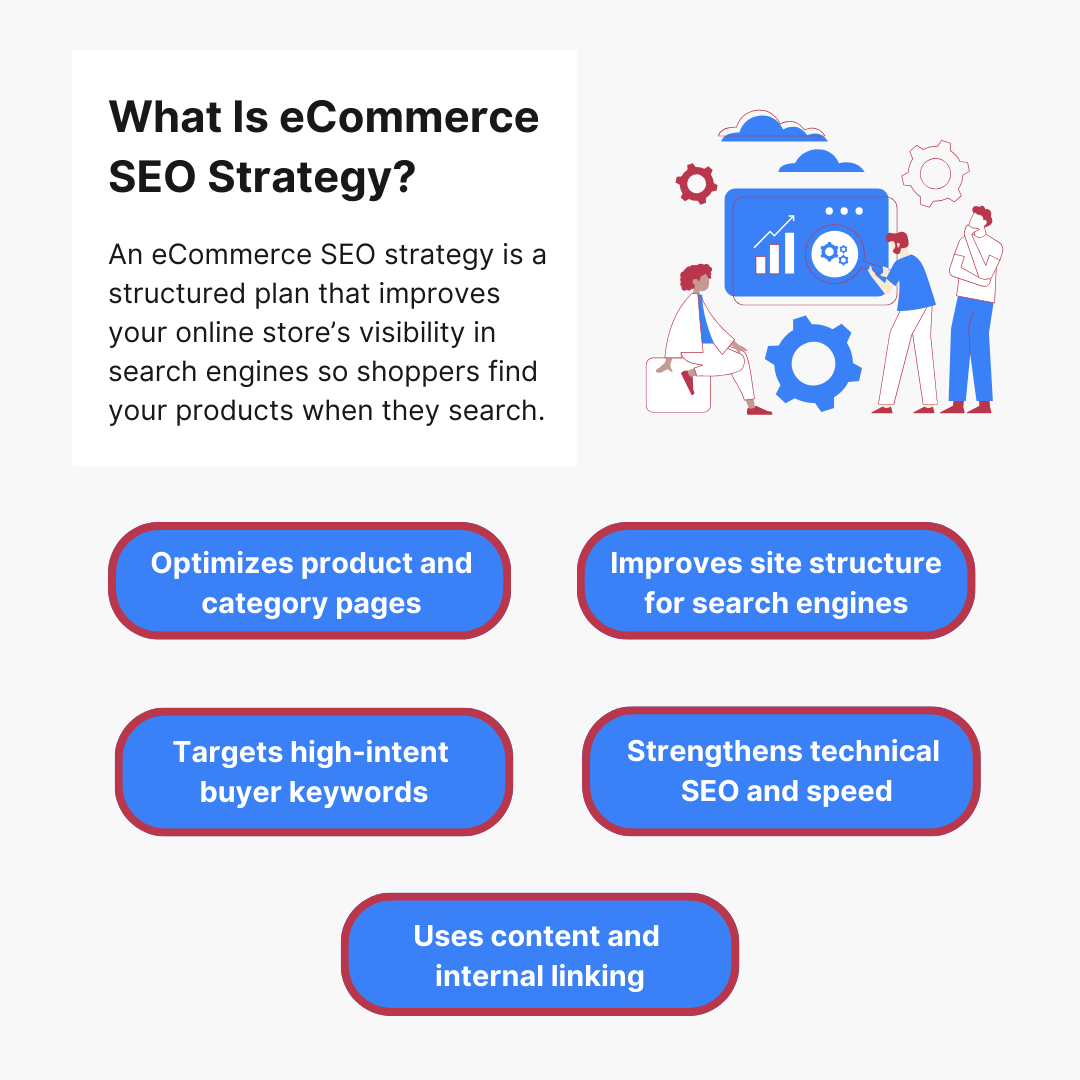
An eCommerce strategy is a plan to improve the visibility of your online store in search engine results, so more people can find your products. It focuses on optimizing your product pages, category pages, site structure, content, and technical SEO to attract the right kind of traffic – people who are ready to buy.
How eCommerce SEO Strategy Helps Online Stores Grow: 5 Key Benefits

When your eCommerce search engine optimization strategy is sorted, things just start working better. More organic traffic, sure – but more of the right traffic. The kind that buys and tells their friends. Here’s what that type of SEO actually does for your store.
1. More Qualified Shoppers Find You
Some clicks matter more than others. With a solid SEO strategy, the people landing on your eCommerce site are usually already looking for what you sell. They are searchers with intent. That means more of your visitors actually want to buy – not just scroll and bounce.
2. Your Products Stay Visible Long-Term
Unlike ads that disappear the second your budget runs out, organic rankings stay. A strong SEO foundation keeps your products visible day after day, month after month. And all of that without ongoing ad spend. Little by little, that visibility builds, and your store stays in front of the right people.
3. You Can Compete with Bigger Brands Without Outspending Them
SEO levels the playing field. You might not have their ad budget, but if your eCommerce website is better optimized, you can outrank them on specific product keywords. Many big brands neglect SEO basics, and that is your window. It is one of the rare times strategy beats budget.
4. Your Whole Marketing Funnel Works Better
When your search optimization is on point, it naturally supports everything else – email signups, retargeting, even social ads. That is because people who discover you through search are further down the funnel. They are already warmed up, which makes all your follow-up marketing way more effective.
5. Trust Builds Without You Pushing It
People trust Google. If your product shows up high in search results, that already sends a message – this store knows what it is doing. You instantly become more credible, without shouting about it in your ads or loading your homepage with trust badges.
9 eCommerce SEO Strategies To Outrank The Competition
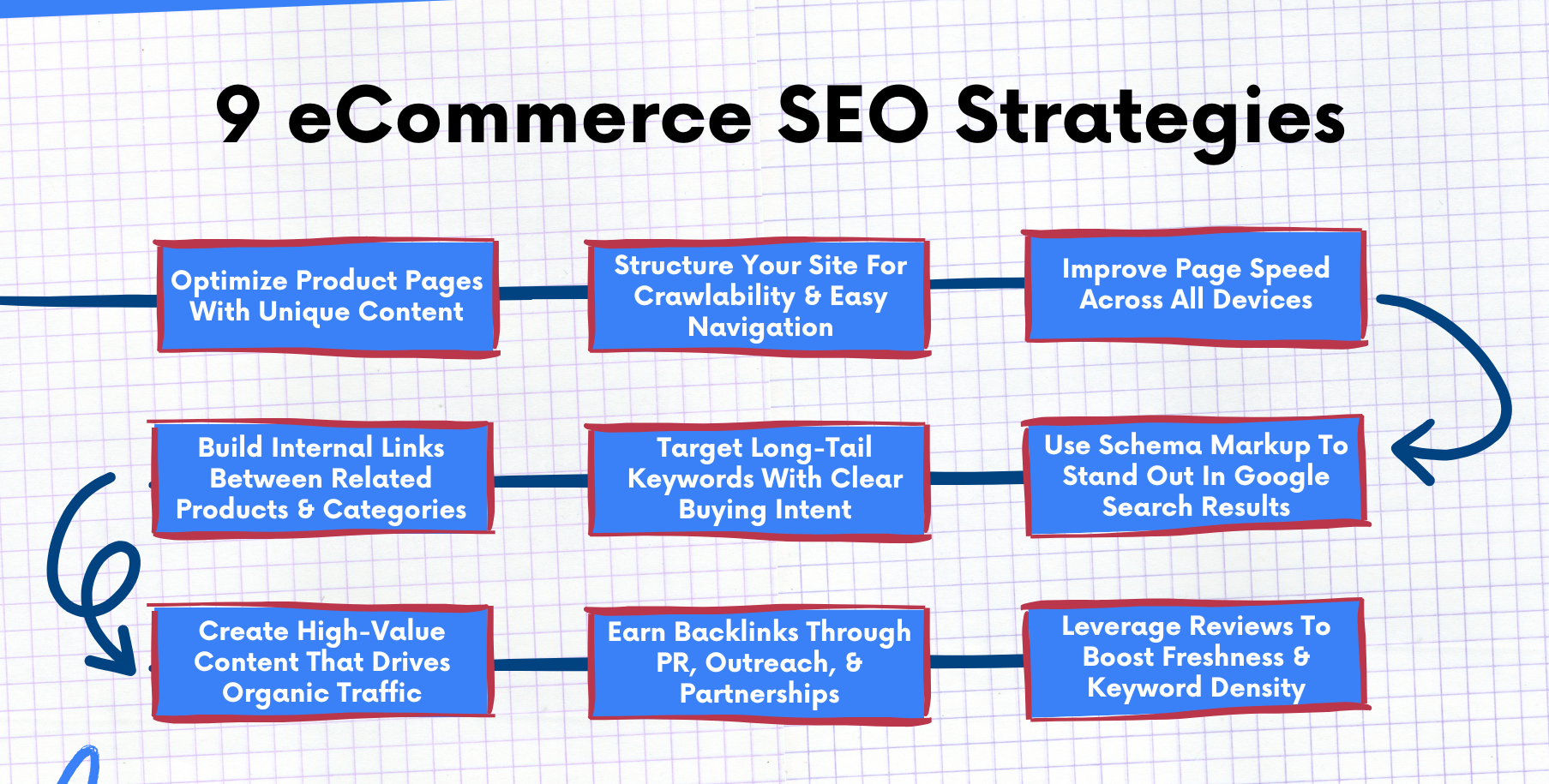
Doing a hundred things halfway won’t do any good if you are trying to beat the competition in search. It is about doing a few things really well. These 9 eCommerce strategies are foundational.
1. Optimize Product Pages With Unique, Keyword-Rich Content
Search engines have very little reason to pay attention if your product pages just repeat manufacturer descriptions or use the same 3 lines across every listing. The goal here is to turn product and category pages into self-contained answers for every question a buyer might have.
Here’s how to make your product pages actually pull in traffic through on-page SEO:
- Ditch generic descriptions. Write fresh copy for every product. Yes, every single one. And talk like your customer thinks.
- Use relevant keywords naturally. Find what people actually search using eCommerce keyword research tools like Ahrefs or Amazon autocomplete. Build your content around those terms.
- Expand your content. Add usage tips, care instructions, size guides, customer FAQs – make each page a mini knowledge base to attract visitors.
- Write for scanners. Use bullet points and clear subheadings so users and search engines can take in information quickly.
2. Structure Your Site For Crawlability & Easy Navigation
Google won’t care how great your content is if it can’t crawl your site easily. And users bounce too if they can’t find what they want in a few clicks.
Here’s how to fix both at once:
- Flat > deep site structure. Keep important pages no more than 3 clicks away from the homepage. More than that, and both users and crawlers lose interest.
- Use a logical category hierarchy. Be clean and intuitive:
Home > Men’s Clothing > Shirts > Casual Shirts
That is easier for Google and your customers to follow than some cryptic tag-based structure.
- Submit an XML sitemap to Google Search Console. It gives search engines a clear path to follow.
- Don’t bury your best stuff. Your top-performing products or categories shouldn’t be hidden 5 layers deep in a random dropdown. Put them front and center.
3. Improve Page Speed Across All Devices
Slow pages kill conversions and search engine rankings. Google doesn’t have patience. And neither do shoppers, especially on mobile.
Here’s how to speed things up:
- Compress your images. Use tools like TinyPNG or ShortPixel. No product image should be over 300–500KB.
- Use next-gen formats. WebP > JPEG/PNG. Smaller files. Same quality. Better performance.
- Remove unnecessary scripts. Every extra tracking pixel or bloated plugin adds drag. Audit and delete what you don’t need.
- Use lazy loading. Especially for product thumbnails and long category pages, don’t load everything at once.
- Move to a better host or use a CDN. If your site takes more than 3 seconds to load, your hosting setup might be the problem.
- Use Google Analytics to identify high bounce rates or underperforming pages.
4. Use Schema Markup To Stand Out In Google Search Results
This one doesn’t boost rankings directly. But it makes your listings look better, which means more clicks. And more clicks = better engagement, which does help search rankings.
Here’s how to get schema working for you:
- Start with the Product schema. This is the core one – price, availability, reviews, etc. It adds those gold stars and price tags you see in search.
- Add Breadcrumb schema. It helps Google understand your site structure and often shows in the search engine results pages (SERPs).
- Use Review schema (carefully). If you have verified customer reviews, mark them up. But don’t fake it – Google is strict on this now.
- Use Google’s Rich Results Test to make sure your markup is working. Just pasting in JSON-LD isn’t enough – check how it renders.
- Automate it if needed. Shopify or BigCommerce has plugins or built-in options. Just make sure they are actually outputting a clean and valid schema.
5. Target Long-Tail Keywords With Clear Buying Intent
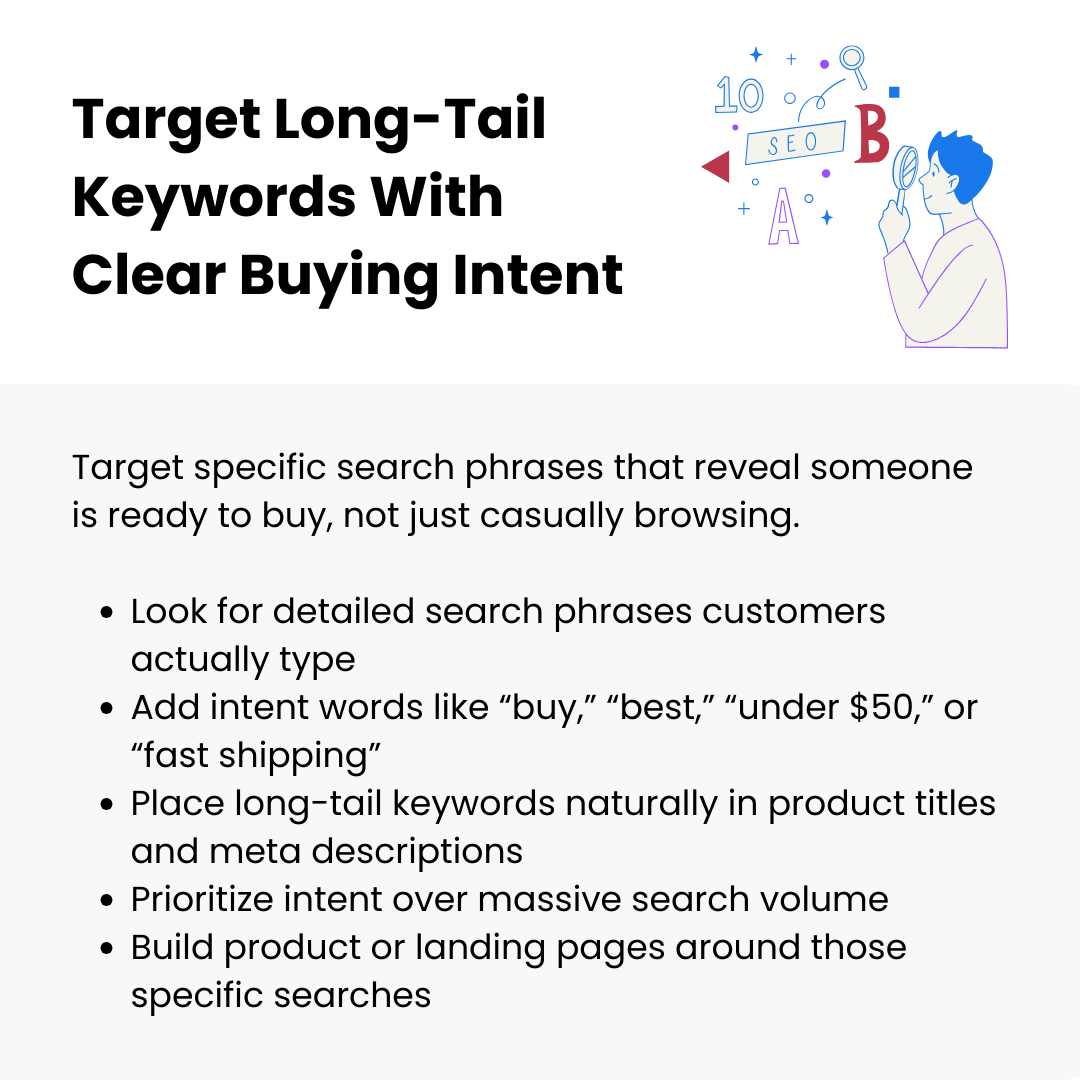
Ranking for “sneakers” sounds nice, but it is a war zone. And most of the people searching that term are just browsing. Long-tail keywords are where the real money is because they bring people who are already halfway to checkout.
Here’s what to do:
- Perform keyword research for specifics. Tools like Google Keyword Planner or Reddit threads are goldmines to get keyword ideas.
- Focus on modifiers. Target keywords like “buy,” “discount,” “durable,” “under $50,” or “fast shipping” because they show buying intent. Add those into product titles and meta descriptions.
- Check keyword difficulty and search volume, but don’t obsess. Long-tails won’t have massive traffic, but the search intent is there. And conversion rate makes up for it.
- Write with purpose. Create landing pages or blog content specifically around these informational keywords.
6. Build Internal Links Between Related Products & Categories
Internal linking is one of those small things that makes a big difference. It keeps shoppers exploring and spreads authority across your pages.
Here’s how to do it:
- Link related products directly. On each product page, add a “You might also like” section that actually makes sense.
- Use contextual links in product descriptions. Got a winter jacket? If you mention layering, link to your thermal base layers.
- Interlink category pages. For instance, if you have a “Beachwear” category, link it from both “Summer Essentials” and “Swimwear.”
- Avoid orphan pages. Every product or category should have at least one internal link pointing to it. If Google can’t find it, it is as good as invisible.
7. Create High-Value Content That Drives Organic Traffic
People don’t wake up thinking, “I need to read a brand blog today.” So if your content is boring or self-promotional, it is doing nothing for you. Plus, this is where most stores flatline – they publish a few blogs, get bored, and stall. But if you push here, this is how you overcome eCommerce plateaus and start pulling in traffic that compounds.
You should:
- Think beyond products – tutorials, how-to guides, buyer comparisons, checklists. Give people useful content that solves a problem or answers a question.
- Map content to the customer journey.
- Early stage: “How to choose the right mattress size”
- Middle stage: “Best memory foam mattresses under $500”
- Purchase-ready: “Top-rated queen-size mattresses with cooling gel”
- Add internal links to relevant products. Subtly. Naturally. Don’t shove a sale in their face. Just make the next step easy.
- Refresh old content. If your old blogs are still getting traffic, add new advice and republish. Google loves freshness.
8. Earn High-Quality Backlinks Through PR, Outreach, & Partnerships
Backlinks are powerful. They show Google that others vouch for you. The more high-quality sites link to you, the more credible your store becomes.
Do this for link-building:
- Pitch stories to niche blogs and media outlets. Editors are always looking for new content.
- Partner with complementary brands. Quality link swaps can happen naturally this way.
- Create link-worthy assets – data studies, trend reports, gift guides, infographics. People want to link to helpful or visual content.
- Clean up unlinked mentions. Use Ahrefs or BrandMentions to find where your store is mentioned without a link. Ask them nicely to add it.
9. Leverage User Reviews To Boost Freshness & Keyword Density
You write your product description once. Your customers write new content for you every time they leave a review. And search engines love that user-generated content.
Do this:
- Encourage detailed reviews. Ask specific post-purchase questions like “What did you use the product for?” These get richer and more keyword-rich responses.
- Show reviews directly on product pages. Not hidden under a tab. Not buried below 20 scrolls. Right there, feeding Google fresh content constantly.
- Respond to reviews. Not only does this show your brand is active, but it also adds more user-generated content for Google to crawl.
- Highlight specific reviews. Got a glowing review that calls out key product benefits or long-tail phrases? Feature it near the top of the page. That keyword optimization magic deserves attention.
5 Common Mistakes In eCommerce SEO & How To Avoid Them
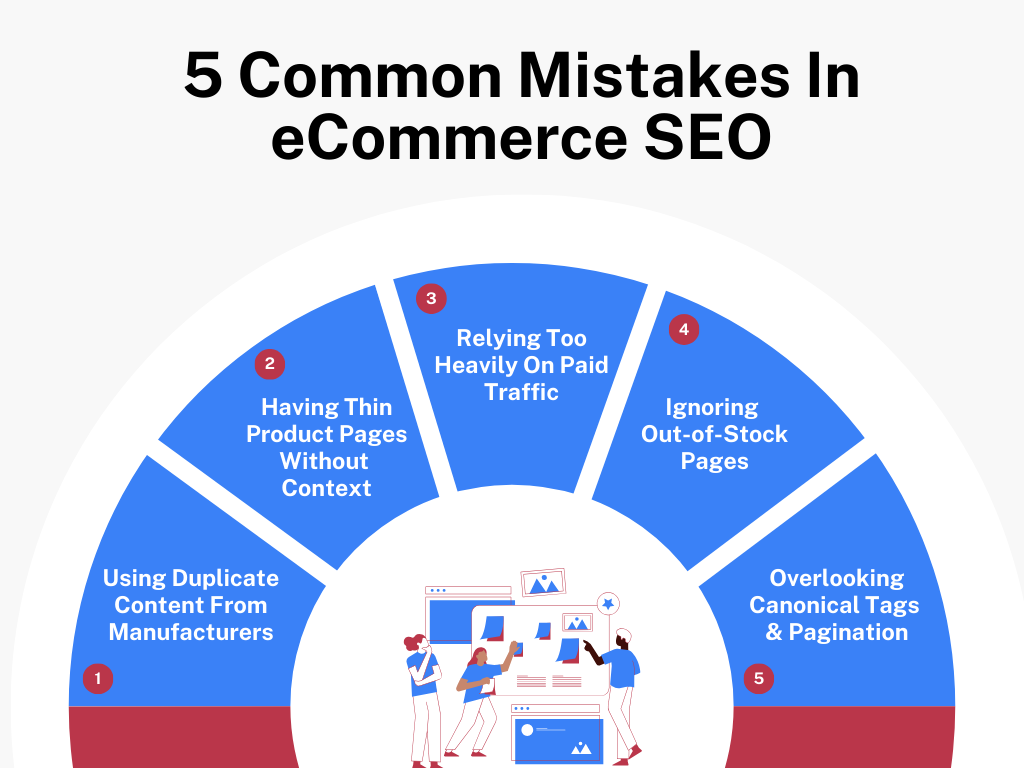
A few wrong steps can hold your store back in organic search. You might not even realize they are hurting your SEO efforts until your rankings plateau or traffic just stalls. Let’s fix that.
1. Using Duplicate Content From Manufacturers
It is tempting to just copy and paste the product description straight from the brand’s website, especially if you have hundreds of products. But Google sees that as duplicate content, and it won’t do you any favors.
Why is it a problem:
- You are competing with every other eCommerce store using the same copy.
- Google might rank the manufacturer’s page over yours.
- Your product page offers nothing new or valuable.
What to do instead:
- Add your own voice. Even a few original sentences can have a big impact.
- Include details that the manufacturer didn’t – like customer FAQs or use-case tips.
- If you are short on time, start by rewriting top-selling products first.
2. Having Thin Product Pages Without Context
If your product page just has a price and a couple of specs, Google has no clue what it is about. And neither do your shoppers.
Why it hurts:
- Google sees it as low-value or incomplete.
- You miss chances to rank for secondary keywords.
- Shoppers don’t feel confident enough to buy.
What to add:
- Describe the “why.” Why this shirt? What makes it worth the price? Who is it for?
- Add usage scenarios. Is it perfect for summer concerts? Daily gym wear? Include those details.
- Include microcontent. Size charts, materials, care instructions, even origin stories. Each section adds SEO weight.
3. Relying Too Heavily On Paid Traffic
Paid traffic can give you a short-term boost, but SEO for eCommerce websites builds long-term value. You are building on rented land if you are only running Google Shopping and Meta ads with zero focus on organic.
Why is it risky:
- Ad costs go up. Organic traffic doesn’t.
- If your ad account gets flagged or paused, your sales stop.
- You get more traffic but no brand trust – users see you once and bounce.
What to shift:
- Balance the budget. Put 20–30% of your marketing budget into organic growth.
- Retarget using organic data. Let SEO attract new users, then retarget the warm ones with paid ads. Much cheaper.
- Think long-term. Paid is for velocity. SEO is for stability.
4. Ignoring Out-of-Stock Pages
If you are just adding a “404” or redirecting every out-of-stock item to your homepage, you are destroying perfectly good SEO value.
Why is that a mistake:
- That page might already have links, keyword rankings, and traffic.
- Shoppers might still want info, even if it is sold out.
- Redirecting to the homepage confuses users and search engines.
How to handle them smartly:
- Keep the page live. Add a “notify me” option for restocks. Capture emails while you are at it.
- Show similar in-stock alternatives. Help the customer continue their journey instead of hitting a dead end.
- Use structured data. Mark the item as out of stock using availability in the schema. Google respects that.
5. Overlooking Canonical Tags & Pagination
Technical? Yes. Boring? Maybe. The truth is, canonical tags and pagination may be in your site’s underbelly, but they impact everything above the surface.
What happens when you ignore this:
- Duplicate or near-duplicate web pages start competing with each other.
- Google wastes crawl budget on the wrong things.
- Pagination confuses indexing, especially for large categories.
What you should do:
- Use canonical tags on variants. If you have 10 pages for different shirt colors, pick one as the canonical version, so Google knows which one to rank.
- Fix paginated categories. Use rel=“next” and rel=“prev.” Or make sure your pagination setup is SEO-friendly.
- Audit it quarterly. Use Screaming Frog or Sitebulb to find canonical issues before they get out of hand.
4 Examples Of eCommerce SEO Strategies By Successful Brands You Can Learn From
Let’s look at how these 4 companies approached eCommerce SEO in very specific ways, so you can see exactly what they did and what made it work.
1. Custom Sock Lab
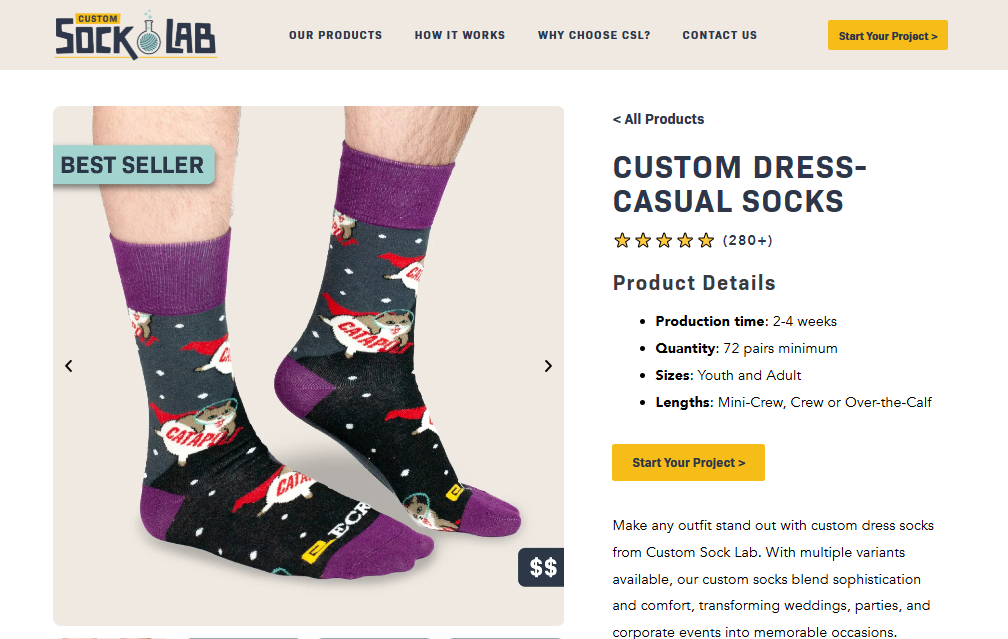
The product page for custom dress socks at Custom Sock Lab does something very smart with information that many brands hide or bury: bulk production details.
Corporate buyers searching for custom merchandise usually search for operational information long before they place an order. The page addresses these concerns directly instead of forcing buyers to request a quote.
They Published Production Details Inside the Product Page
The product page openly discusses order logistics, such as:
- Production lead times
- Minimum quantity requirements
- Packaging options
- Shipping timelines
The page also describes the production process from design approval to final shipment. Each step contains short explanations about how long the stage usually takes. This level of detail creates keyword relevance for manufacturing-related searches.
Pricing Structure That Doubles as SEO Content
Rather than showing only a single price, the page explains price breaks at different quantities. Those explanations include notes about how manufacturing efficiency improves at higher quantities.
That content introduces long-tail phrases like bulk custom socks pricing and large quantity custom sock orders. This type of content attracts buyers who are planning promotional campaigns or employee gifts.
Design File Requirements That Capture Niche Searches
The page also explains how buyers should submit artwork files. It specifies:
- Preferred file formats
- Resolution guidelines
- Logo sizing limits
By documenting these requirements directly on the product page, the brand captures a layer of research-driven searches that competitors usually miss. The result is a page that attracts corporate buyers planning custom merchandise – not just casual shoppers browsing apparel.
2. Sewing Parts Online
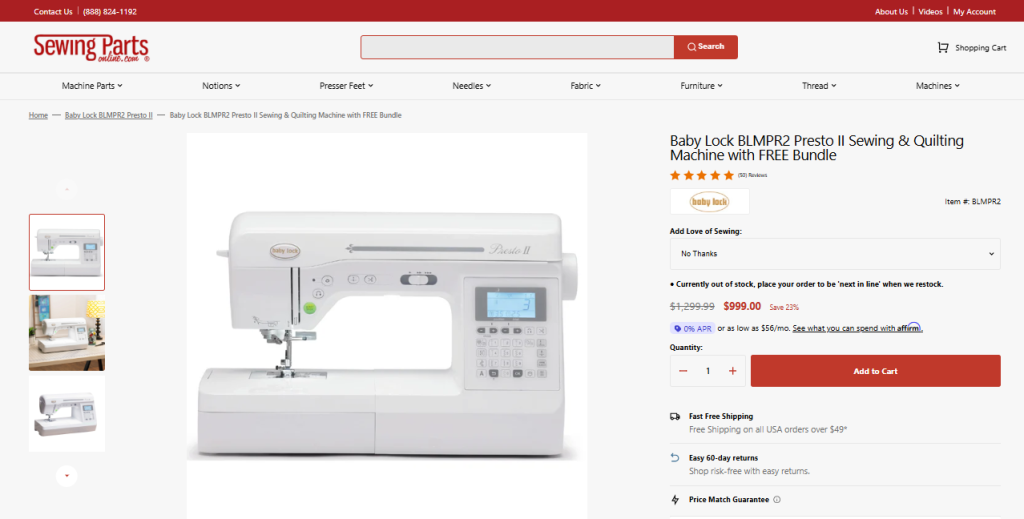
Sewing Parts Online’s page for the Brother SE2000 sewing and embroidery machine quietly targets a very specific kind of search traffic – comparison-based research.
Buyers of sewing machines almost always compare models before making a purchase. Instead of avoiding comparisons, the page focuses on them.
The Description Highlights What Changed From Earlier Models
The product description includes a detailed discussion about improvements compared with earlier machines. For example:
- Expanded embroidery pattern library
- Larger touchscreen display
- Updated USB design transfer features
Each improvement references how the feature differs from previous machines. Search engines pick up phrases related to model upgrades and differences. So someone researching older Brother machines may find this page because the text discusses how the SE2000 evolved.
Embedded Instructional Content
The page contains small educational explanations about features that beginners usually misunderstand, like:
- How embroidery file imports work
- How stitch editing functions operate on the screen
- How the machine switches between sewing and embroidery modes
These explanations answer questions customers often type directly into search engines. And instead of sending readers to a blog tutorial, the product page itself handles the explanation to increase the conversion chances.
Project-Based Keyword Coverage
Another interesting element involves example sewing projects. The page describes projects that work well with the machine, like embroidered pillowcases or decorative quilt borders. These examples introduce additional search phrases around sewing projects. Someone researching embroidery ideas might come across the page while looking for inspiration.
Product Media That Reinforces SEO
Sewing Parts Online includes detailed image captions highlighting the embroidery hoop system or showing the LCD editing interface. These captions contain descriptive text that search engines index. This works because the page behaves like a buyer research guide for a specific sewing machine model.
3. EXT Cabinets
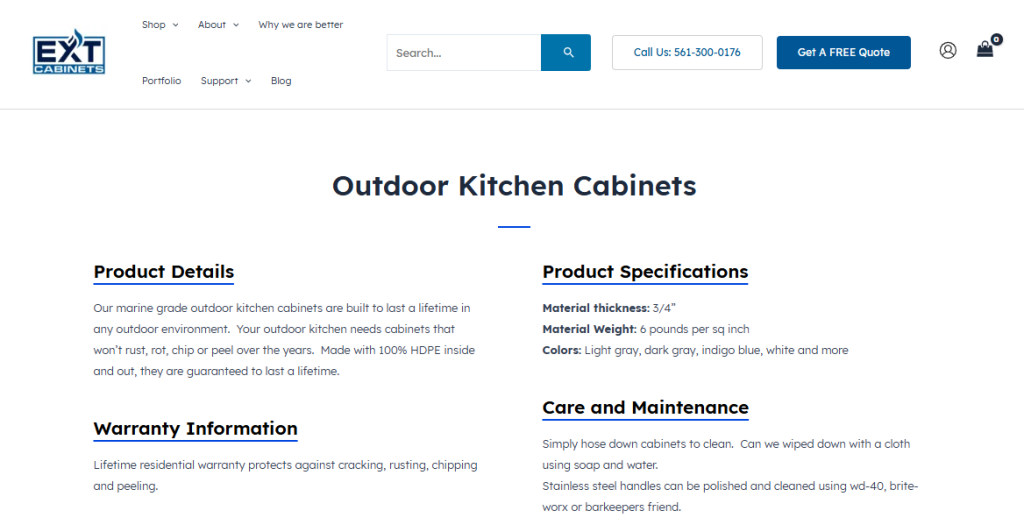
Outdoor kitchens involve a long planning process. People researching them perform dozens of searches before buying a single cabinet.
This page for outdoor kitchen cabinets by EXT Cabinets reflects that reality. Instead of pushing immediate purchases, they focus heavily on layout planning information.
The Page Explains Cabinet Placement Strategy
The content discusses where different cabinet types belong within an outdoor kitchen setup. For example:
- Base cabinets positioned beneath countertop prep areas
- Wall cabinets placed above beverage stations
- Corner cabinets used to connect L-shaped layouts
These sections naturally introduce search phrases like outdoor kitchen cabinet layout or how to design outdoor kitchen cabinets. That attracts users who are still planning their space.
Measurements That Support Design Searches
EXT Cabinets also references cabinet dimensions in a very practical way. Examples include:
- Typical cabinet depth for grill islands
- Recommended clearance space between cabinets and grills
- Cabinet height alignment with outdoor countertops
Many homeowners search for dimension-related queries while planning their outdoor kitchen. Those searches align perfectly with the detailed measurements presented on the page.
Content About Weather Performance
EXT Cabinets discusses how cabinets handle outdoor environments. They talk about drainage design for rain exposure or ventilation features for enclosed cabinets. These discussions create search relevance around weather durability, a common concern for outdoor kitchen buyers.
Installation Context
The page references how the cabinets integrate with materials such as stone countertops, concrete patio foundations, and built-in grill systems. Those references connect the cabinets to a broader outdoor kitchen ecosystem. Search engines recognize those contextual relationships and understand that the page addresses complete outdoor kitchen construction topics.
4. CodaPet
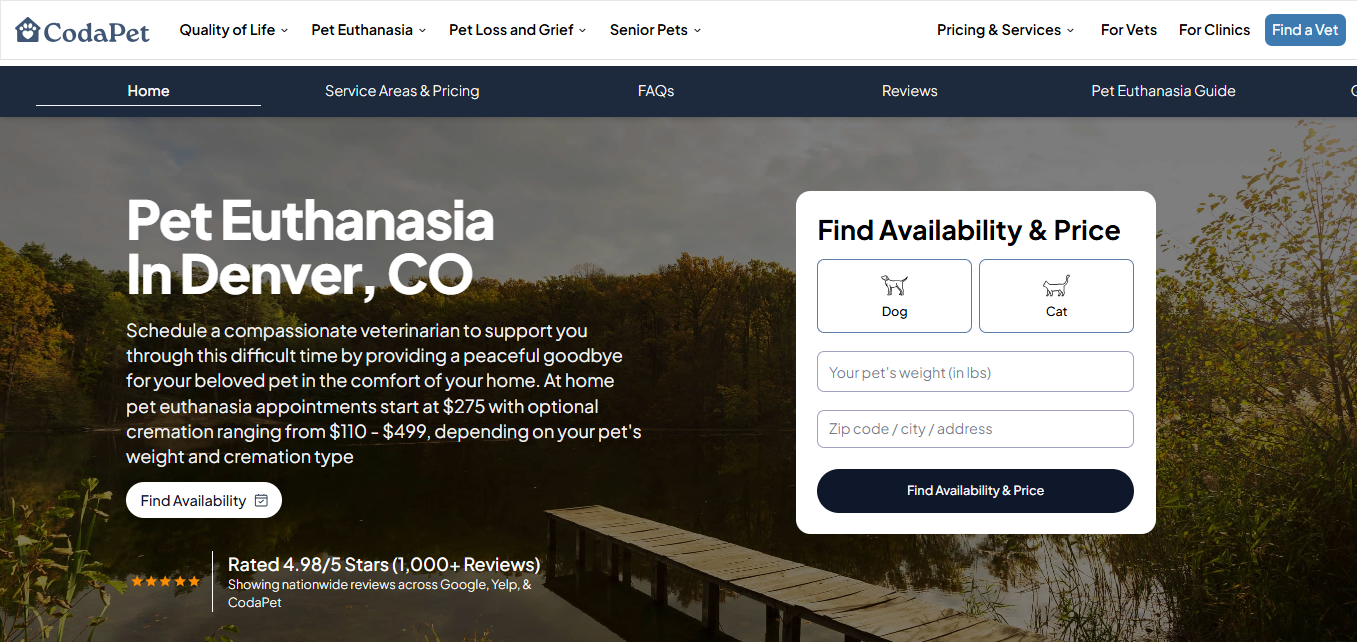
While CodaPet isn’t traditional eCommerce, its SEO execution is worth bookmarking for lessons. Their page for at-home pet euthanasia in Denver demonstrates one of the strongest location-based SEO executions you will see. Each city page works almost like a mini website dedicated to one location.
They Wrote Content That Reflects the City Itself
The page includes mentions of pet owners living in high-rise apartments downtown and families in suburban neighborhoods surrounding the city. These references connect the service to Denver’s environment and lifestyle.
Search engines interpret these references as clear geographic signals. And the page becomes highly relevant for searches that include Denver-specific intent.
The Page Introduces Local Veterinarians
Profiles of veterinarians include details like years working in Colorado clinics and their approach to in-home pet care. These profiles create original and location-specific content that differs from other city pages. That uniqueness prevents duplicate content issues across locations.
The Service Description Reflects Real Appointments
The page describes how a typical in-home visit unfolds. It explains:
- How veterinarians arrive with medical equipment
- How families prepare their pet’s resting space
- How the veterinarian explains the process during the visit
This level of detail answers questions that pet owners search for during emotional decision-making moments.
Local Service Logistics
CodaPet also explains practical details specifically for the city, like scheduling availability across Denver neighborhoods and travel coverage throughout the metro region.
These details introduce highly localized search phrases such as mobile pet euthanasia Denver suburbs or in-home vet services Denver area. Because the page answers those queries thoroughly, it becomes extremely visible for local service searches.
Conclusion
Most eCommerce businesses aren’t failing because of bad products; they are just invisible – hidden somewhere on page 6.
But if you have made it this far, you already know better. An eCommerce SEO strategy is the backbone of sustainable growth. It is about building a store that is worth finding, and then making damn sure it gets found. So yes, higher search engine rankings matter. But they are the side effects of doing the right things consistently.
That is exactly the mindset we work with at SiteWired. Since 1998, we have been helping businesses perform as real sales engines. When we build or optimize an eCommerce site, we look at the whole picture.
That includes the structure of your store, how your product pages are organized, how fast your pages load, how your checkout experience works, and how search engines actually crawl and understand your content. This all becomes part of the process, so your visibility grows naturally over time.
Get a free quote or schedule a meeting with our team, and we will walk through your website together and show you exactly where the biggest SEO opportunities are.