Denver-Based Agency · Since 1998

999 18th Street, Suite 3012

Denver, CO 80202

303-424-2522

GEO vs AEO: Understanding the Key Differences Between GEO and AEO

GEO vs AEO represent two distinct but complementary strategies for gaining visibility in the rapidly evolving AI search landscape

sitewired

Updated on:
April 15, 2026

Introduction: GEO vs AEO

GEO vs AEO represent two distinct but complementary strategies for gaining visibility in the rapidly evolving AI search landscape. Generative Engine Optimization (GEO) targets how large language models like ChatGPT, Claude, and Perplexity cite and reference content in AI-generated responses, while Answer Engine Optimization (AEO) focuses on positioning content as the extractable answer for featured snippets, voice assistants, and Google’s AI Overviews.

Today, users expect quick, concise answers, leading to a significant shift in search behavior toward AI-driven platforms. AI answer engines, such as ChatGPT and Google’s AI modes, are rapidly being adopted as the new form of search tools, providing direct, personalized responses to user queries and often replacing traditional blue link search results. These platforms generate ai answers by pulling information from a variety of sources, including search engines and dedicated AI answer engines like Perplexity. As a result, optimizing your content to appear in these AI answers is increasingly important for maintaining visibility.

The rise of AI-driven search tools is causing significant concern among businesses about the future of traditional SEO, and the shift from traditional search engines to answer engines represents a crucial evolution for brands, marketers, and content creators. AEO is becoming essential for maintaining visibility as AI increasingly mediates the information discovery process.

GEO vs AEO

This content covers the fundamental differences between these optimization approaches, their technical requirements, and practical implementation strategies for digital marketers, SEO professionals, content strategists, and business owners navigating AI powered answer engines. Whether you’re deciding where to allocate resources or building a comprehensive AI visibility strategy, understanding these distinctions will shape how people search for and discover your brand.

The core distinction: GEO optimizes content to become a trusted, authoritative source that generative AI platforms cite in multi-source summaries, while search engine optimization (SEO) focuses on ranking in search engine results pages, and answer engine optimization (AEO) structures content for immediate extraction as direct answers in zero-click searches and voice search results.

By the end of this guide, you will:

  • Understand the fundamental mechanisms separating GEO from AEO
  • Know when to prioritize each strategy based on business objectives
  • Have a clear framework for implementing both approaches
  • Recognize how to measure success across different AI systems
  • Learn to integrate both strategies for comprehensive search engine results pages visibility

Zero-click searches are on the rise, with more than half of all Google searches ending without the user clicking a traditional result link, making AEO crucial for visibility.

Understanding Generative Engine Optimization (GEO)

Generative Engine Optimization is the practice of optimizing content to be cited, referenced, or synthesized within AI-generated answers from tools like ChatGPT, Perplexity, Claude, and Google Gemini. Unlike traditional SEO aims to rank blue links, GEO focuses on becoming a source that AI models trust enough to include in their synthesized responses.

GEO works through Retrieval-Augmented Generation (RAG) pipelines, where AI engines first retrieve relevant documents based on relevance signals, then generate answers that cite authoritative sources. RAG techniques enable AI systems to produce more accurate and relevant AI-generated outputs by utilizing up-to-date external sources beyond their initial training data. This means your content must be retrievable, semantically clear, and credible enough for inclusion in conversational, multi-turn dialogues across multiple AI platforms.

Core GEO Principles

GEO success depends on building signals that make AI systems recognize your content as authoritative and trustworthy. This includes comprehensive topical coverage, clear entity recognition, strong backlink profiles, and consistent brand mentions across the web.

Content strategy for GEO prioritizes depth over brevity. AI models synthesizing information from multiple sources favor content that demonstrates expertise through statistics, expert quotes, original research, and unique insights that distinguish your perspective from competitors.

GEO Goals and Outcomes

The primary outcome of effective GEO is consistent citation across generative AI platforms when users ask complex questions in your domain. Rather than appearing as a standalone snippet, your brand becomes part of the AI’s synthesized understanding of a topic.

Long-term benefits include brand recognition in AI-generated summaries, authority status within large language models’ knowledge bases, and visibility that persists even as traditional organic search traffic patterns shift toward zero-click searches.

Understanding Answer Engine Optimization (AEO)

Answer engine optimization focuses on positioning content as the immediate, extractable response for user queries in featured snippets, AI overviews, and voice search results. AEO targets the “give me the answer” queries where users want concise answers rather than comprehensive exploration.

AEO works with how search engines interpret content for extraction, leveraging natural language processing to match conversational queries with structured, easily parsed content. What makes answer engines powerful is their ability to deliver direct, concise responses and synthesize information from multiple sources, transforming how users interact with information online. AI search engines use natural language processing to interpret the context and intent behind user queries, which is essential for effective AEO. This approach directly targets answer engines like Google Assistant, Siri, and Alexa, as well as the answer engine results that appear in traditional search engines.
Analyzing AEO ranking answer engine optimization via artificial intelligence technology cloud network enterprise resource workflow database

Core AEO Principles

Structured data implementation sits at the heart of AEO. Schema markup—including FAQPage, HowTo, and Q&A schemas—makes content machine-readable, allowing AI tools to confidently extract and present your answer. You should validate structured data regularly to maintain eligibility for featured snippets.

Content format matters significantly for AEO. Direct question-answer structures, bullet points, numbered lists, and a dedicated FAQ section increase the likelihood of extraction. Matching conversational phrasing patterns helps capture voice search queries that mirror natural speech.

AEO Goals and Outcomes

The immediate goal of answer engine optimization is to appear in zero-click searches—featured snippets, knowledge panel answers, or voice assistant responses. This positions your content as the single best answer for specific user queries.

Success in AEO means capturing “position zero” visibility, driving brand awareness even without clicks, and establishing authority for factual, quick-answer queries where users prioritize speed over depth.

Key Differences Between GEO and AEO

Building on the foundational understanding of each approach, a detailed comparison framework reveals how these strategies diverge in their mechanisms, requirements, and outcomes.

GEO vs AEO: Do You Need Both?

The short answer is yes—but with strategic prioritization based on your business goals. GEO and AEO address different user behaviors and search landscape dynamics. GEO captures the “help me understand” queries in AI chatbots and conversational search, while AEO dominates the “give me the fact” queries in conventional search engines.

Organizations seeing the highest AI visibility gains (15-25% more AI mentions according to recent benchmarks) typically implement both approaches, allocating resources based on their content type and audience needs.

Timeline and Strategy Focus

GEO operates on longer timelines, building authority that influences how AI models understand and cite your brand over months or years. The focus is on creating content that is comprehensive enough to serve as part of AI training data and knowledge retrieval systems.

AEO delivers faster results, often showing featured snippet wins within weeks of optimization. The strategy centers on content structure and formatting rather than broad authority building, making it ideal for quick wins in specific query categories.

GEO requires presence across multiple platforms to establish the trust signals AI systems use when selecting sources. AEO typically targets specific search engine features—particularly Google’s AI Overviews and voice assistants—where structured content is prioritized for extraction.

Content Requirements Comparison

CriterionGEOAEO
Content DepthComprehensive, expert-level coverageConcise, extractable answers
Primary FormatLong-form with statistics, citations, and unique insightsStructured lists, tables, Q&A format
Schema MarkupHelpful but not primaryEssential for extraction
Technical FocusEntity clarity, topical authority, site structureSchema markup, direct answers, voice search optimization
Content Creation VolumeFewer, deeper piecesMore targeted, question-specific content
Update FrequencyPeriodic for authority maintenanceFrequent for competitive snippets

Technical implementation diverges significantly. AEO requires rigorous schema markup implementation, core web vitals optimization, and site speed improvements that help search engines interpret and extract content efficiently. GEO emphasizes backlink profiles, brand mentions, content depth, and signals that establish credibility for machine learning systems assessing source reliability.

Measurement and Success Metrics

GEO measurement remains challenging given the opacity of AI companies’ systems. Key metrics include tracking brand mentions in AI responses via monitoring tools, analyzing citation frequency across AI platforms, and measuring authority signals such as backlink quality and topical relevance scores.

AEO metrics align more closely with traditional SEO tracking: featured snippet appearances, voice search results rankings, answer engine results visibility, and organic traffic from zero-click searches where users engage with your brand despite not clicking through to your own website.
Magnifying glass with ai symbol on a world map background, representing SEO, AEO, and GEO concepts with an upward arrow

Site Structure and GEO

A well-structured website is foundational to effective Generative Engine Optimization (GEO). Unlike traditional SEO, where site structure primarily aids search engines in crawling and ranking pages, GEO requires a site architecture that enables AI engines to easily interpret, contextualize, and extract information for inclusion in AI-generated answers.

To optimize your site structure for GEO, start by establishing a clear hierarchy of pages that logically group related content. Use descriptive, keyword-rich URLs that signal each page’s topic and relevance to both users and AI systems. Implement a robust internal linking strategy that connects cornerstone content with supporting articles to help AI engines understand the relationships and context between topics. This interconnected structure not only improves navigation for users but also increases the likelihood that AI-generated responses will reference your most authoritative content.

Additionally, technical performance is critical to optimizing AI platforms. Ensure your website is mobile-friendly and loads quickly, as slow or poorly optimized sites can hinder AI engines from efficiently crawling and indexing your content. Adhering to core web vitals—such as page speed, interactivity, and visual stability—further enhances your site’s accessibility to AI systems, increasing the chances of being cited in AI-generated responses.

By prioritizing a logical site structure, descriptive URLs, strategic internal linking, and technical excellence, you position your website as a reliable source for AI engines seeking authoritative information to include in their AI-generated answers.


Strategic Implementation Framework

Combining GEO and AEO creates a comprehensive AI search strategy that captures visibility across the full spectrum of user intent—from quick factual queries to complex exploratory conversations.

When to Prioritize GEO

Industries built on expertise and thought leadership benefit most from GEO-first approaches. Professional services, B2B SaaS, healthcare, and financial services often see stronger returns from becoming cited authorities in AI-generated responses.

Brands seeking consistent recognition across multiple AI platforms should prioritize GEO. If your competitive advantage lies in expertise that AI models should recognize when synthesizing answers, building that authority through a comprehensive content strategy takes precedence.

Content strategies focused on long tail queries and complex topics favor GEO. When user queries require synthesis from multiple sources—“best CRM for startups with remote teams,” for instance—GEO positions your content as a trusted component of the AI’s answer.

When to Prioritize AEO

Local businesses targeting immediate search visibility benefit from AEO-first strategies. Optimizing your Google Business Profile, implementing local schema, and targeting voice search queries like “plumber near me” deliver faster results than authority-building campaigns.

E-commerce sites optimizing for product-related queries should prioritize AEO. Structured product data, FAQ sections addressing common purchase questions, and content formatted for featured snippets capture users at decision points.

Service providers targeting quick-answer search behaviors—“how to fix a leaky faucet,” “what documents do I need for a mortgage”—find AEO delivers immediate organic search traffic gains through featured snippet visibility.
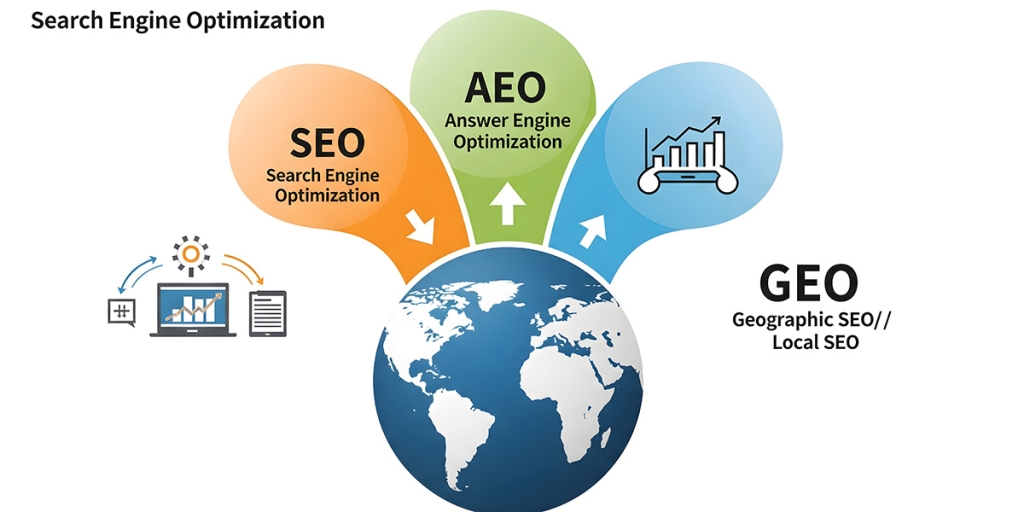
GEO vs AEO and  SEO, The Triad of Search Engine Optimization Strategies for Global Digital Marketing Success

Integrated GEO + AEO Strategy

Implementing both approaches requires a systematic process:

  1. Audit current AI visibility across both traditional search engines and generative AI platforms to establish baselines
  2. Map content to user intent categories—separating quick-answer queries (AEO priority) from complex exploratory topics (GEO priority)
  3. Implement foundational technical SEO, including schema markup, site structure optimization, and core web vitals improvements that support both strategies
  4. Create depth-first content for GEO targets, then extract key facts and structure them for AEO visibility
  5. Build authority signals through consistent content creation, backlink acquisition, and brand mention cultivation
  6. Monitor and iterate using AI visibility tools alongside traditional search analytics

Resource allocation should typically favor 60% toward your priority strategy, based on the business model, with 40% allocated to the complementary approach. A blog post optimized for GEO depth can include structured FAQ sections for AEO extraction, maximizing returns from each content investment.

Common Challenges and Solutions

Practical implementation of both strategies encounters predictable obstacles that require specific solutions.

GEO Implementation Challenges

Measuring long-term AI influence proves difficult when AI companies don’t provide transparent citation analytics. Solution: Implement regular AI response auditing using tools that query multiple platforms for your brand terms, tracking mention frequency and context over time.

Building sufficient authority for AI citation recognition demands sustained effort before results appear. Solution: Focus initial GEO efforts on narrow topic clusters where you can establish comprehensive coverage, then expand systematically.

AEO Implementation Challenges

The technical complexity of schema markup and structured data implementation creates barriers for teams without development resources. Solution: Use schema markup generators and validation tools, prioritizing high-impact schema types (FAQPage, HowTo) before comprehensive implementation.

Competition for limited featured snippet positions means not every optimized page wins extraction. Target question variations and long-tail queries with lower competition, using people search data to identify underserved queries.

Resource Management Challenges

Balancing immediate AEO needs with long-term GEO investment strains content teams with limited capacity. Solution: Design content that serves both purposes—comprehensive guides (GEO) with structured extraction points (AEO) embedded throughout.

Tracking ROI across different AI optimization strategies requires new measurement frameworks. Solution: Establish leading indicators (schema implementation, content depth scores, authority metrics) alongside lagging indicators (citations, snippet wins, organic traffic) for each approach.

Future of GEO and AEO

The future of Generative Engine Optimization (GEO) and Answer Engine Optimization (AEO) is being shaped by rapid advancements in artificial intelligence and natural language processing, and by the evolution of user search behaviors. As AI models become more sophisticated, they will be able to interpret user queries with greater nuance and generate more accurate, context-rich answers—raising the bar for content that appears in AI-generated answers across multiple AI platforms.

To remain competitive, businesses will need to adopt advanced engine optimization techniques that go beyond traditional SEO. This includes large language model optimization, in which content is crafted to align with how AI models process and synthesize information, as well as entity- and intent-based optimization strategies that help AI systems match your content to specific user queries. As answer engine optimization AEO continues to evolve, structured data and concise, direct answers will remain essential for capturing featured snippets and voice search results.

The rise of voice search and conversational AI assistants is also transforming the search landscape. Users are increasingly turning to voice-enabled devices and AI chatbots for quick, conversational answers, often using long tail queries that require content to be both comprehensive and easily extractable. To succeed, your SEO strategy must account for these shifts by optimizing for multiple AI platforms, ensuring your content is accessible, well-structured, and tailored to the natural language patterns of modern search.

Staying ahead in this dynamic environment means continuously monitoring AI trends, updating your optimization tactics, and investing in high-quality, authoritative content that meets the evolving standards of AI-generated responses. By embracing the future of GEO and AEO, businesses can secure lasting visibility and authority in an increasingly AI-driven search ecosystem.

Conclusion and Next Steps

GEO and AEO serve complementary roles in a comprehensive AI search strategy. GEO builds the long-term authority that makes AI assistants cite your brand in synthesized responses, while AEO captures immediate visibility in featured snippets, voice search, and AI overviews. Neither approach alone addresses the full spectrum of how AI systems generate answers and how user behavior is evolving.

Immediate actionable steps:

  1. Audit your current AI visibility by querying your brand and topic terms in ChatGPT, Perplexity, and Google’s AI Overviews
  2. Choose your primary focus based on whether your business needs immediate snippet visibility (AEO) or long-term authority building (GEO)
  3. Implement foundational technical SEO, including schema markup and site structure optimization
  4. Create one comprehensive content piece targeting a priority topic with embedded structured data for extraction
  5. Establish monitoring for both AI citations and featured snippet performance

Related exploration topics include technical SEO foundations for AI visibility, content authority building through expertise signals, and emerging AI search monitoring tools that track performance across generative AI platforms.

Additional Resources: GEO vs AEO

  • AI search visibility audit tools: Perplexity, ChatGPT, and Claude for manual monitoring; specialized platforms like Profound and Otterly for systematic tracking
  • Schema markup generators: Google’s Structured Data Markup Helper, Schema.org documentation, and Merkle’s Schema Markup Generator for implementation
  • Content authority building strategies: Topical cluster frameworks, expert citation cultivation, and brand mention monitoring through tools like Mention and Brand24
  • Measurement frameworks: Combined dashboards tracking traditional search console data alongside AI citation frequency across multiple platforms

GEO vs AEO represent two distinct but complementary strategies for gaining visibility in the rapidly evolving AI search landscape. Generative Engine Optimization (GEO) targets how large language models like ChatGPT, Claude, and Perplexity cite and reference content in AI-generated responses, while Answer Engine Optimization (AEO) focuses on positioning content as the extractable answer for featured snippets, voice assistants, and Google’s AI Overviews.

Today, users expect quick, concise answers, leading to a significant shift in search behavior toward AI-driven platforms. AI answer engines, such as ChatGPT and Google’s AI modes, are rapidly being adopted as the new form of search tools, providing direct, personalized responses to user queries and often replacing traditional blue link search results. These platforms generate ai answers by pulling information from a variety of sources, including search engines and dedicated AI answer engines like Perplexity. As a result, optimizing your content to appear in these AI answers is increasingly important for maintaining visibility.

The rise of AI-driven search tools is causing significant concern among businesses about the future of traditional SEO, and the shift from traditional search engines to answer engines represents a crucial evolution for brands, marketers, and content creators. AEO is becoming essential for maintaining visibility as AI increasingly mediates the information discovery process.

GEO vs AEO

This content covers the fundamental differences between these optimization approaches, their technical requirements, and practical implementation strategies for digital marketers, SEO professionals, content strategists, and business owners navigating AI powered answer engines. Whether you’re deciding where to allocate resources or building a comprehensive AI visibility strategy, understanding these distinctions will shape how people search for and discover your brand.

The core distinction: GEO optimizes content to become a trusted, authoritative source that generative AI platforms cite in multi-source summaries, while search engine optimization (SEO) focuses on ranking in search engine results pages, and answer engine optimization (AEO) structures content for immediate extraction as direct answers in zero-click searches and voice search results.

By the end of this guide, you will:

  • Understand the fundamental mechanisms separating GEO from AEO
  • Know when to prioritize each strategy based on business objectives
  • Have a clear framework for implementing both approaches
  • Recognize how to measure success across different AI systems
  • Learn to integrate both strategies for comprehensive search engine results pages visibility

Zero-click searches are on the rise, with more than half of all Google searches ending without the user clicking a traditional result link, making AEO crucial for visibility.

Understanding Generative Engine Optimization (GEO)

Generative Engine Optimization is the practice of optimizing content to be cited, referenced, or synthesized within AI-generated answers from tools like ChatGPT, Perplexity, Claude, and Google Gemini. Unlike traditional SEO aims to rank blue links, GEO focuses on becoming a source that AI models trust enough to include in their synthesized responses.

GEO works through Retrieval-Augmented Generation (RAG) pipelines, where AI engines first retrieve relevant documents based on relevance signals, then generate answers that cite authoritative sources. RAG techniques enable AI systems to produce more accurate and relevant AI-generated outputs by utilizing up-to-date external sources beyond their initial training data. This means your content must be retrievable, semantically clear, and credible enough for inclusion in conversational, multi-turn dialogues across multiple AI platforms.

Core GEO Principles

GEO success depends on building signals that make AI systems recognize your content as authoritative and trustworthy. This includes comprehensive topical coverage, clear entity recognition, strong backlink profiles, and consistent brand mentions across the web.

Content strategy for GEO prioritizes depth over brevity. AI models synthesizing information from multiple sources favor content that demonstrates expertise through statistics, expert quotes, original research, and unique insights that distinguish your perspective from competitors.

GEO Goals and Outcomes

The primary outcome of effective GEO is consistent citation across generative AI platforms when users ask complex questions in your domain. Rather than appearing as a standalone snippet, your brand becomes part of the AI’s synthesized understanding of a topic.

Long-term benefits include brand recognition in AI-generated summaries, authority status within large language models’ knowledge bases, and visibility that persists even as traditional organic search traffic patterns shift toward zero-click searches.

Understanding Answer Engine Optimization (AEO)

Answer engine optimization focuses on positioning content as the immediate, extractable response for user queries in featured snippets, AI overviews, and voice search results. AEO targets the “give me the answer” queries where users want concise answers rather than comprehensive exploration.

AEO works with how search engines interpret content for extraction, leveraging natural language processing to match conversational queries with structured, easily parsed content. What makes answer engines powerful is their ability to deliver direct, concise responses and synthesize information from multiple sources, transforming how users interact with information online. AI search engines use natural language processing to interpret the context and intent behind user queries, which is essential for effective AEO. This approach directly targets answer engines like Google Assistant, Siri, and Alexa, as well as the answer engine results that appear in traditional search engines.

Analyzing AEO ranking answer engine optimization via artificial intelligence technology cloud network enterprise resource workflow database

Core AEO Principles

Structured data implementation sits at the heart of AEO. Schema markup—including FAQPage, HowTo, and Q&A schemas—makes content machine-readable, allowing AI tools to confidently extract and present your answer. You should validate structured data regularly to maintain eligibility for featured snippets.

Content format matters significantly for AEO. Direct question-answer structures, bullet points, numbered lists, and a dedicated FAQ section increase the likelihood of extraction. Matching conversational phrasing patterns helps capture voice search queries that mirror natural speech.

AEO Goals and Outcomes

The immediate goal of answer engine optimization is to appear in zero-click searches—featured snippets, knowledge panel answers, or voice assistant responses. This positions your content as the single best answer for specific user queries.

Success in AEO means capturing “position zero” visibility, driving brand awareness even without clicks, and establishing authority for factual, quick-answer queries where users prioritize speed over depth.

Key Differences Between GEO and AEO

Building on the foundational understanding of each approach, a detailed comparison framework reveals how these strategies diverge in their mechanisms, requirements, and outcomes.

GEO vs AEO: Do You Need Both?

The short answer is yes—but with strategic prioritization based on your business goals. GEO and AEO address different user behaviors and search landscape dynamics. GEO captures the “help me understand” queries in AI chatbots and conversational search, while AEO dominates the “give me the fact” queries in conventional search engines.

Organizations seeing the highest AI visibility gains (15-25% more AI mentions according to recent benchmarks) typically implement both approaches, allocating resources based on their content type and audience needs.

Timeline and Strategy Focus

GEO operates on longer timelines, building authority that influences how AI models understand and cite your brand over months or years. The focus is on creating content that is comprehensive enough to serve as part of AI training data and knowledge retrieval systems.

AEO delivers faster results, often showing featured snippet wins within weeks of optimization. The strategy centers on content structure and formatting rather than broad authority building, making it ideal for quick wins in specific query categories.

GEO requires presence across multiple platforms to establish the trust signals AI systems use when selecting sources. AEO typically targets specific search engine features—particularly Google’s AI Overviews and voice assistants—where structured content is prioritized for extraction.

Content Requirements Comparison

CriterionGEOAEO
Content DepthComprehensive, expert-level coverageConcise, extractable answers
Primary FormatLong-form with statistics, citations, and unique insightsStructured lists, tables, Q&A format
Schema MarkupHelpful but not primaryEssential for extraction
Technical FocusEntity clarity, topical authority, site structureSchema markup, direct answers, voice search optimization
Content Creation VolumeFewer, deeper piecesMore targeted, question-specific content
Update FrequencyPeriodic for authority maintenanceFrequent for competitive snippets

Technical implementation diverges significantly. AEO requires rigorous schema markup implementation, core web vitals optimization, and site speed improvements that help search engines interpret and extract content efficiently. GEO emphasizes backlink profiles, brand mentions, content depth, and signals that establish credibility for machine learning systems assessing source reliability.

Measurement and Success Metrics

GEO measurement remains challenging given the opacity of AI companies’ systems. Key metrics include tracking brand mentions in AI responses via monitoring tools, analyzing citation frequency across AI platforms, and measuring authority signals such as backlink quality and topical relevance scores.

AEO metrics align more closely with traditional SEO tracking: featured snippet appearances, voice search results rankings, answer engine results visibility, and organic traffic from zero-click searches where users engage with your brand despite not clicking through to your own website.

Magnifying glass with ai symbol on a world map background, representing SEO, AEO, and GEO concepts with an upward arrow

Site Structure and GEO

A well-structured website is foundational to effective Generative Engine Optimization (GEO). Unlike traditional SEO, where site structure primarily aids search engines in crawling and ranking pages, GEO requires a site architecture that enables AI engines to easily interpret, contextualize, and extract information for inclusion in AI-generated answers.

To optimize your site structure for GEO, start by establishing a clear hierarchy of pages that logically group related content. Use descriptive, keyword-rich URLs that signal each page’s topic and relevance to both users and AI systems. Implement a robust internal linking strategy that connects cornerstone content with supporting articles to help AI engines understand the relationships and context between topics. This interconnected structure not only improves navigation for users but also increases the likelihood that AI-generated responses will reference your most authoritative content.

Additionally, technical performance is critical to optimizing AI platforms. Ensure your website is mobile-friendly and loads quickly, as slow or poorly optimized sites can hinder AI engines from efficiently crawling and indexing your content. Adhering to core web vitals—such as page speed, interactivity, and visual stability—further enhances your site’s accessibility to AI systems, increasing the chances of being cited in AI-generated responses.

By prioritizing a logical site structure, descriptive URLs, strategic internal linking, and technical excellence, you position your website as a reliable source for AI engines seeking authoritative information to include in their AI-generated answers.


Strategic Implementation Framework

Combining GEO and AEO creates a comprehensive AI search strategy that captures visibility across the full spectrum of user intent—from quick factual queries to complex exploratory conversations.

When to Prioritize GEO

Industries built on expertise and thought leadership benefit most from GEO-first approaches. Professional services, B2B SaaS, healthcare, and financial services often see stronger returns from becoming cited authorities in AI-generated responses.

Brands seeking consistent recognition across multiple AI platforms should prioritize GEO. If your competitive advantage lies in expertise that AI models should recognize when synthesizing answers, building that authority through a comprehensive content strategy takes precedence.

Content strategies focused on long tail queries and complex topics favor GEO. When user queries require synthesis from multiple sources—“best CRM for startups with remote teams,” for instance—GEO positions your content as a trusted component of the AI’s answer.

When to Prioritize AEO

Local businesses targeting immediate search visibility benefit from AEO-first strategies. Optimizing your Google Business Profile, implementing local schema, and targeting voice search queries like “plumber near me” deliver faster results than authority-building campaigns.

E-commerce sites optimizing for product-related queries should prioritize AEO. Structured product data, FAQ sections addressing common purchase questions, and content formatted for featured snippets capture users at decision points.

Service providers targeting quick-answer search behaviors—“how to fix a leaky faucet,” “what documents do I need for a mortgage”—find AEO delivers immediate organic search traffic gains through featured snippet visibility.

GEO vs AEO and  SEO, The Triad of Search Engine Optimization Strategies for Global Digital Marketing Success

Integrated GEO + AEO Strategy

Implementing both approaches requires a systematic process:

  1. Audit current AI visibility across both traditional search engines and generative AI platforms to establish baselines
  2. Map content to user intent categories—separating quick-answer queries (AEO priority) from complex exploratory topics (GEO priority)
  3. Implement foundational technical SEO, including schema markup, site structure optimization, and core web vitals improvements that support both strategies
  4. Create depth-first content for GEO targets, then extract key facts and structure them for AEO visibility
  5. Build authority signals through consistent content creation, backlink acquisition, and brand mention cultivation
  6. Monitor and iterate using AI visibility tools alongside traditional search analytics

Resource allocation should typically favor 60% toward your priority strategy, based on the business model, with 40% allocated to the complementary approach. A blog post optimized for GEO depth can include structured FAQ sections for AEO extraction, maximizing returns from each content investment.

Common Challenges and Solutions

Practical implementation of both strategies encounters predictable obstacles that require specific solutions.

GEO Implementation Challenges

Measuring long-term AI influence proves difficult when AI companies don’t provide transparent citation analytics. Solution: Implement regular AI response auditing using tools that query multiple platforms for your brand terms, tracking mention frequency and context over time.

Building sufficient authority for AI citation recognition demands sustained effort before results appear. Solution: Focus initial GEO efforts on narrow topic clusters where you can establish comprehensive coverage, then expand systematically.

AEO Implementation Challenges

The technical complexity of schema markup and structured data implementation creates barriers for teams without development resources. Solution: Use schema markup generators and validation tools, prioritizing high-impact schema types (FAQPage, HowTo) before comprehensive implementation.

Competition for limited featured snippet positions means not every optimized page wins extraction. Target question variations and long-tail queries with lower competition, using people search data to identify underserved queries.

Resource Management Challenges

Balancing immediate AEO needs with long-term GEO investment strains content teams with limited capacity. Solution: Design content that serves both purposes—comprehensive guides (GEO) with structured extraction points (AEO) embedded throughout.

Tracking ROI across different AI optimization strategies requires new measurement frameworks. Solution: Establish leading indicators (schema implementation, content depth scores, authority metrics) alongside lagging indicators (citations, snippet wins, organic traffic) for each approach.

Future of GEO and AEO

The future of Generative Engine Optimization (GEO) and Answer Engine Optimization (AEO) is being shaped by rapid advancements in artificial intelligence and natural language processing, and by the evolution of user search behaviors. As AI models become more sophisticated, they will be able to interpret user queries with greater nuance and generate more accurate, context-rich answers—raising the bar for content that appears in AI-generated answers across multiple AI platforms.

To remain competitive, businesses will need to adopt advanced engine optimization techniques that go beyond traditional SEO. This includes large language model optimization, in which content is crafted to align with how AI models process and synthesize information, as well as entity- and intent-based optimization strategies that help AI systems match your content to specific user queries. As answer engine optimization AEO continues to evolve, structured data and concise, direct answers will remain essential for capturing featured snippets and voice search results.

The rise of voice search and conversational AI assistants is also transforming the search landscape. Users are increasingly turning to voice-enabled devices and AI chatbots for quick, conversational answers, often using long tail queries that require content to be both comprehensive and easily extractable. To succeed, your SEO strategy must account for these shifts by optimizing for multiple AI platforms, ensuring your content is accessible, well-structured, and tailored to the natural language patterns of modern search.

Staying ahead in this dynamic environment means continuously monitoring AI trends, updating your optimization tactics, and investing in high-quality, authoritative content that meets the evolving standards of AI-generated responses. By embracing the future of GEO and AEO, businesses can secure lasting visibility and authority in an increasingly AI-driven search ecosystem.

Conclusion and Next Steps

GEO and AEO serve complementary roles in a comprehensive AI search strategy. GEO builds the long-term authority that makes AI assistants cite your brand in synthesized responses, while AEO captures immediate visibility in featured snippets, voice search, and AI overviews. Neither approach alone addresses the full spectrum of how AI systems generate answers and how user behavior is evolving.

Immediate actionable steps:

  1. Audit your current AI visibility by querying your brand and topic terms in ChatGPT, Perplexity, and Google’s AI Overviews
  2. Choose your primary focus based on whether your business needs immediate snippet visibility (AEO) or long-term authority building (GEO)
  3. Implement foundational technical SEO, including schema markup and site structure optimization
  4. Create one comprehensive content piece targeting a priority topic with embedded structured data for extraction
  5. Establish monitoring for both AI citations and featured snippet performance

Related exploration topics include technical SEO foundations for AI visibility, content authority building through expertise signals, and emerging AI search monitoring tools that track performance across generative AI platforms.

Additional Resources: GEO vs AEO

  • AI search visibility audit tools: Perplexity, ChatGPT, and Claude for manual monitoring; specialized platforms like Profound and Otterly for systematic tracking
  • Schema markup generators: Google’s Structured Data Markup Helper, Schema.org documentation, and Merkle’s Schema Markup Generator for implementation
  • Content authority building strategies: Topical cluster frameworks, expert citation cultivation, and brand mention monitoring through tools like Mention and Brand24
  • Measurement frameworks: Combined dashboards tracking traditional search console data alongside AI citation frequency across multiple platforms