

Project: Brand-New Website Design, Development & SEO Architecture
Client: Denver Surface Solutions — denversurfacesolutions.com
Market: Denver Metro, CO
Industry: Residential & Commercial Surface Cleaning / Dispensary Mitigation
THE CHALLENGE
Three audiences, no web presence, and a differentiated service that nobody knew existed
Denver Surface Solutions launched with something genuinely uncommon in the residential and commercial cleaning market: a founder with 15 years of hands-on experience in oil and gas processing and petrochemical refinement. That background produces a fundamentally different methodology — chemistry-matched to surface type, industrial-grade equipment, zero-tolerance execution — but a methodology nobody can see if there’s no website to communicate it.
The first problem was straightforward: build from zero. No domain authority, no citation profile, no Google Business history. In a local services market where trust signals carry outsized weight, starting from scratch in Denver is a legitimate challenge.
The second problem was harder: this company serves three customer segments with completely different psychology. A homeowner searching for carpet cleaning, a commercial property manager needing HACCP-compliant floor work, and a dispensary operator navigating MED compliance requirements are not the same buyer. They search differently, respond to different trust signals, and have different objections before picking up the phone. A single generic page — the default for most cleaning company websites — would fail all three.
Denver Market Context
The dispensary mitigation cleaning niche in Colorado is genuinely underserved online. Most cannabis operations have real regulatory exposure around odor, air quality, and documentation — and almost no cleaning companies are equipped to address it credibly. That’s a real SEO opportunity, and a conversion opportunity, for a company that can demonstrate compliance-level competence.
Our Approach
Search intent first — then architecture, then design
Most web design projects start with aesthetics. We start with a different question: what does a visitor need to see, in what order, before they’ll submit a form? For Denver Surface Solutions, the answer was authority and specificity — proof that this isn’t a company showing up with a rented steam cleaner.
Service architecture driven by search intent
We built the site around three dedicated service verticals — Residential, Commercial, and Dispensary Mitigation — each with its own page, its own content strategy, and its own conversion path. This isn’t just an organizational preference. Someone searching “carpet cleaning Denver” and someone searching “MED compliant dispensary cleaning Denver” are at different awareness levels and have different objections. Sending both to the same page is a conversion problem and an SEO problem.
Each service page was written to match the vocabulary and intent of that specific buyer. The commercial page speaks the language of a facilities manager — CIP procedures, ATP testing, HACCP standards, 24-hour emergency response. The residential page speaks to a homeowner who’s skeptical of the generic cleaning company and wants to understand the process. The dispensary page leads with compliance, documentation, and discretion — because that’s what that buyer needs to hear first.
“We treat every surface the way industrial facilities treat high-value assets — surface identification, proper chemistry, disciplined execution.”— Denver Surface Solutions founder, 15 years oil & gas / petrochemical background
Transparent pricing as a conversion mechanism
One of the more deliberate decisions on the residential section was publishing a full pricing table — per-room carpet cleaning rates, hard surface sq/ft pricing, add-on options. This runs against the instinct of many service businesses, who prefer to quote everything by consultation. But transparent pricing does something important: it pre-qualifies. The visitor who sees “$75 per room” and keeps reading is already past the price objection. It also signals confidence — a company willing to put real numbers on a public page has nothing to hide, which is its own trust signal in a market full of vague “call for a quote” pages.
For commercial and dispensary services, where scope genuinely varies, we kept pricing consultation-based but gave enough process detail and credential context that a facilities manager or operations director could self-qualify before reaching out.
Credentials front-loaded, not buried
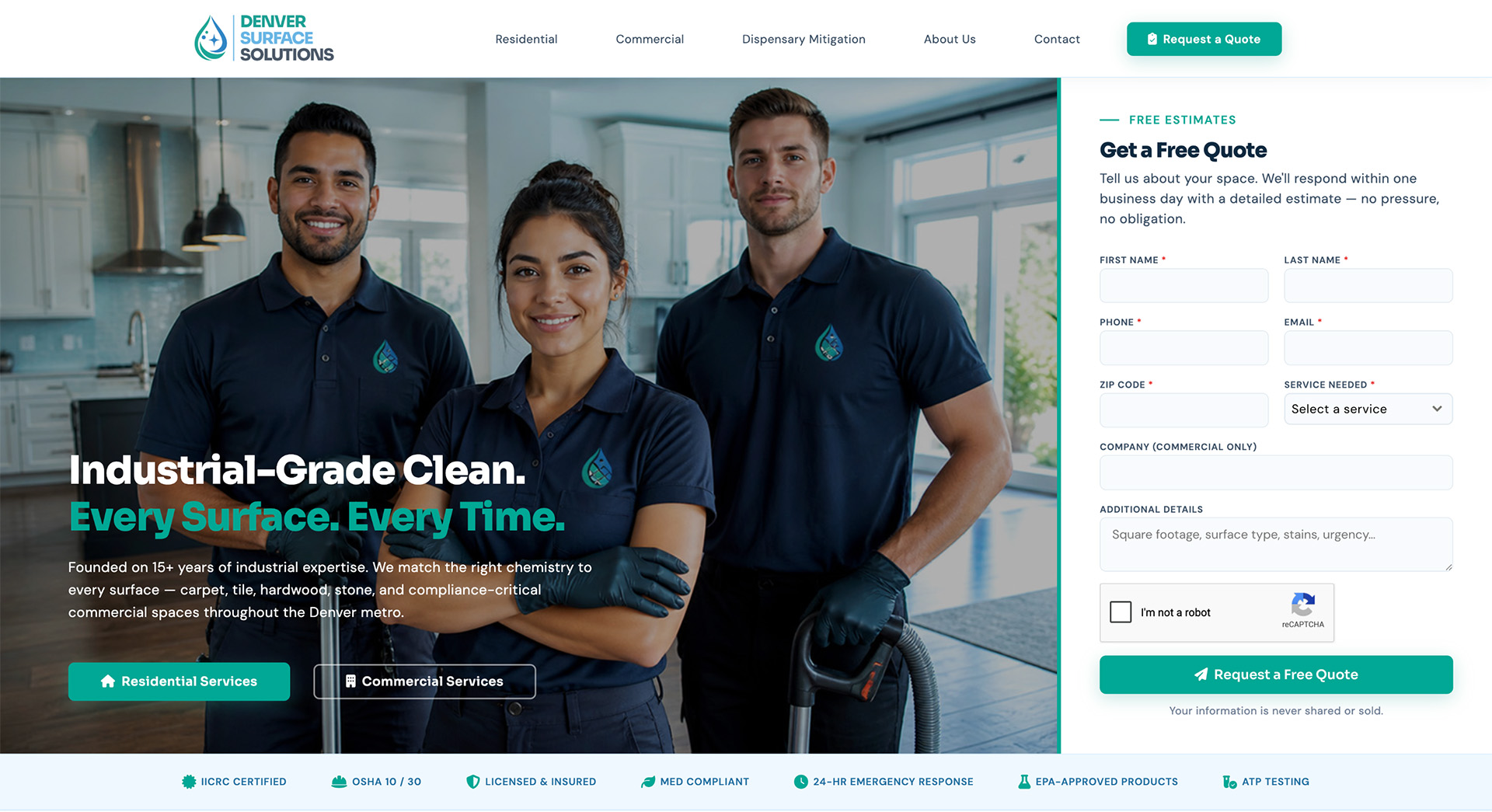
IICRC certified. OSHA 10/30. MED compliant. EPA-approved products. ATP testing. These aren’t footnotes — they’re the reason a property manager or dispensary operator would choose this company over a less credentialed competitor at a lower price. We surfaced them in the hero trust bar, reinforced them in every service section, and used them as the anchor for the commercial and dispensary conversion blocks. The About page was written to give the industrial backstory the weight it deserves, because buyers who care about expertise actually read it — and so do Google’s quality evaluators.
EEAT Signal: Real Expertise, Not Borrowed Authority
The founder’s oil and gas background isn’t a marketing angle — it’s the literal origin of the company’s methodology. Chemistry-matched cleaning agents, surface assessment before any work begins, and ATP testing for verification are standard practice in petrochemical facilities. Translating that discipline into a cleaning service is the actual differentiator. The content reflects that, because search engines and discerning buyers both respond to demonstrated expertise over generic claims.Deliverables
What we built — and why each piece exists
Homepage
Authority-first hero, inline quote form above the fold, service overview by vertical, trust bar with credentials, transparent residential pricing, commercial CTA.
Residential Page
Written for a skeptical homeowner. Covers carpet, hard surface, tile & grout, hardwood, and LVP/LVT with process detail and published pricing.
Commercial Page
Speaks to facilities managers and industrial operators. CIP, ATP testing, HACCP, OSHA 10/30, and 24-hr emergency response front and center.
Dispensary Mitigation Page
Denver’s most detailed page for MED-compliant cannabis facility cleaning. Odor remediation, HEPA air scrubbing, documented service records, discreet scheduling.
About Page
Anchors the industrial origin story as the company’s core differentiator. Written to build trust with buyers who do their research before calling.
SEO Architecture
Reverse silo internal linking structure, local business schema markup, clean URL structure ready for the cluster content buildout in phase two.
The entire site was built on WordPress — our preferred platform for local service businesses because it gives clients full content ownership while supporting the kind of technical SEO architecture new sites need from day one. The reverse silo linking structure was baked in from the start, not retrofitted later: service pages cross-link to supporting content, and every page funnels authority toward the three main verticals. The quote request form lives above the fold on the homepage and is the target of every CTA on the site.
Once the site launched, we moved it onto our managed hosting infrastructure and enrolled it in ongoing website maintenance. For a brand-new company, uptime, security, and plugin integrity aren’t optional — they’re part of protecting the investment we just built together.
The Niche Opportunity
Why the dispensary mitigation page might be the most valuable page on the site
Cannabis dispensaries and cultivation operations in Colorado have legitimate operational pain points around odor control, air quality, and MED compliance documentation. A single odor complaint can trigger a state inspection. Post-harvest remediation is a recurring need. And documentation of cleaning service — what was done, when, with what products — is part of operating in a regulated environment.
Almost no cleaning companies in Denver are equipped to address this credibly, and almost none have content that speaks to it specifically. From an SEO standpoint, this is an underserved niche with real search demand and thin competition. A company with the right credentials and content built around those specific problems has a genuine path to owning that query space in Denver search — which is exactly what the phase two content strategy is designed to do.
Why This Matters for Local SEO
New domains can’t compete head-on in broad, high-volume categories right away. But they can establish topical authority in underserved niches from the start. Building a credible, detailed page around dispensary mitigation cleaning — with supporting cluster content to follow — is how a brand-new site earns early rankings and real traffic while the domain matures.Phase Two
The website is the platform. The SEO work is what loads it.
Denver Surface Solutions launched with zero domain authority, which means organic search is a long game. But the site was architected from day one to support a content buildout without a rebuild. Phase two is topical authority: cluster pages around high-intent queries in the Denver metro, local citation development, and content targeting commercial and dispensary cleaning searches where competition is thin and search intent is high.
Our local SEO strategy for Denver service businesses isn’t built around keyword density — it’s built around topical completeness and demonstrating that a business actually operates here, understands the local market, and has the expertise to back up its claims. The cluster pages we build for Denver Surface Solutions will target real queries from real buyers across the Front Range — Aurora, Lakewood, Englewood, Arvada — feeding authority back into the three main service pages through deliberate internal linking.
Because we also handle their hosting and ongoing site maintenance, every piece of content we publish goes live on a stable, secure, fast-loading platform. There’s no handoff friction, no version conflicts, no waiting on a third party to push updates. The full stack — design, development, SEO, hosting, and maintenance — runs through one team with one set of priorities.